A Translation Management System (TMS) is a increasingly necessary software tool that helps manage and streamline the translation process for a localization company. It organizes and automates tasks such as assigning translations, managing localization projects, creating customized workflows, and ensuring consistency across different languages. By using a TMS, a localization company can work more efficiently, reduce errors, and deliver high-quality localization faster, making it easier to handle complex projects and meet the needs of their clients. Nowadays, there are many TMS options on the market, offering a wide range of features for various tasks, from assigning linguists to generating budget reports and providing AI assistance. These systems continue to evolve as the latest technological advancements become more accessible.
For this project, we researched, evaluated, and compared five different Translation Management Systems to recommend the most suitable one for a midsize game localization company. Our consultation took into account all critical factors necessary to achieve the company’s business goals, including the capability to localize their primary product into at least five locales. For our research and comparison, we evaluated five well-known management systems:

Who Are Our Stakeholders?
The first factor to consider when choosing a suitable TMS was identifying the key stakeholders in our game localization company who would benefit from or be directly connected to the management system. These stakeholders include:
- Linguists
- Designers
- Writers (script / scenario / key terms)
- Engineers
- Sales Team
- Marketing Team
- Legal Team
- Community (possible translation volunteers – crowdsourcing)
- Customer Support Team
- QA/Game testers
Let’s Talk About Business Requirements
The second focus in this project was the establishment of the most important business requirements this company would have, accordingly to their very specific product and business objectives:
- – Scalability: The ability to accommodate the company’s growth, including new members, locales, and increased work volume.
- – Cost: A cost-effective solution that offers good value for a mid-size company with a limited budget.
- – Usability/Teachability: An intuitive and comprehensive interface with practical training potential for team members.
- – File Formats: Compatibility with all typical file formats used by a game localization company.
- – Workflow Management: Comprehensive and adaptable workflow management features.
- – Cloud-Based: A web-based platform that allows for geographical flexibility for the entire team.
- – Integrations: The ability to integrate essential tools used by a game localization company.
- – AI Integration: Availability of AI tools and integration options beneficial to a game localization company.
- – Legality: Ensuring the TMS provides and maintains crucial legal protections for our products and work materials.
Team Research and Comparison Discussions
We established a simple three-level criteria and score system to vote on the features observed in each requirement:

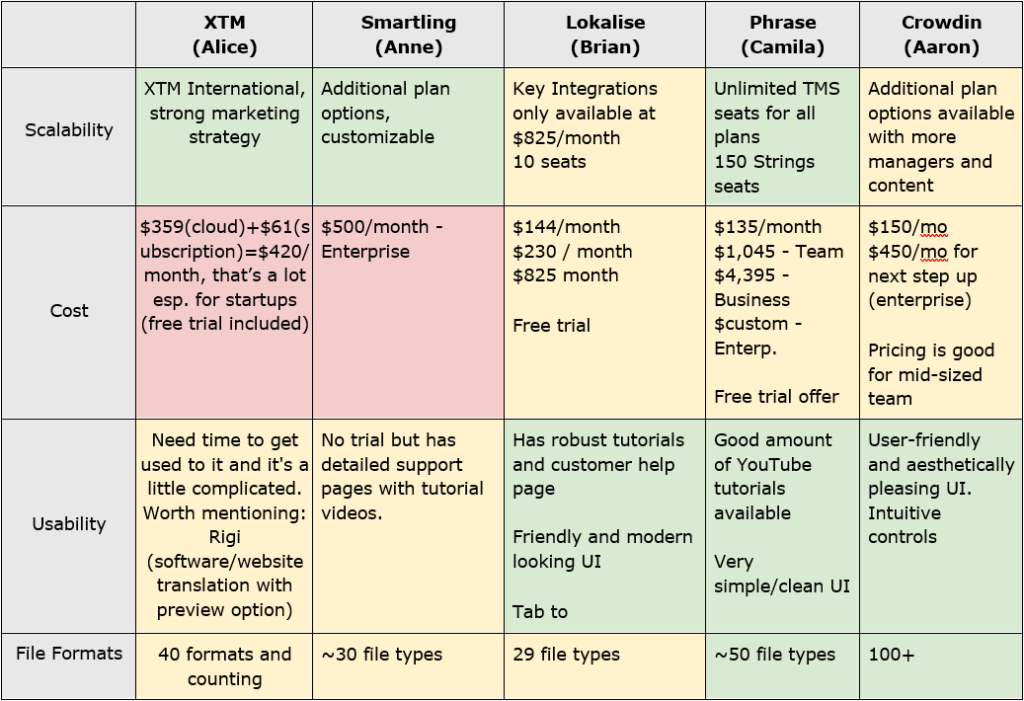
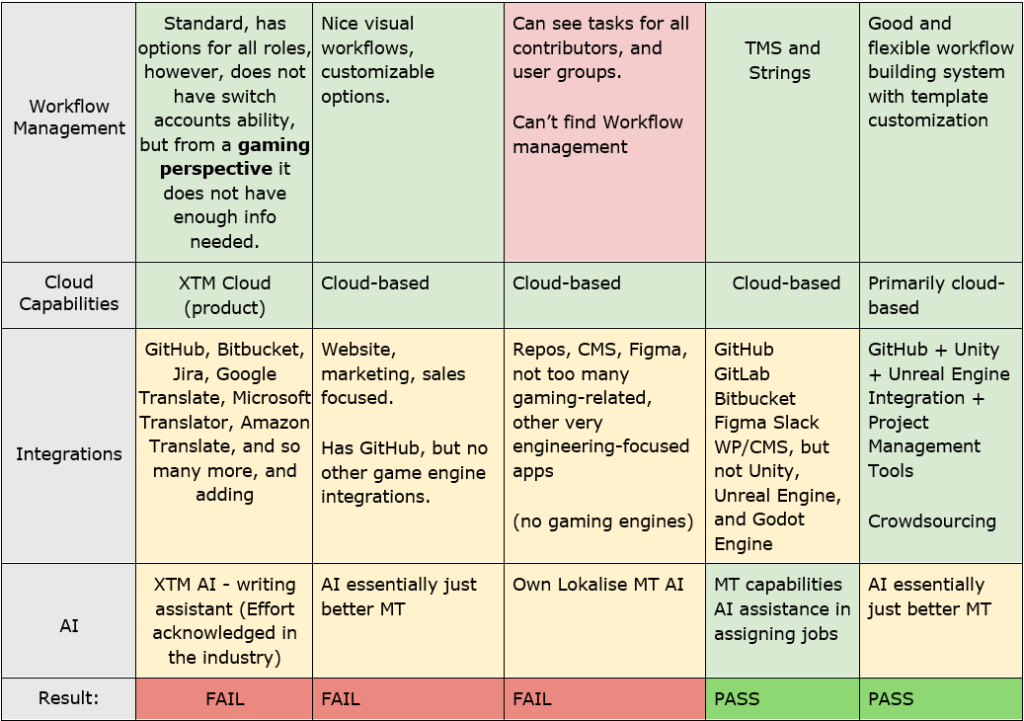
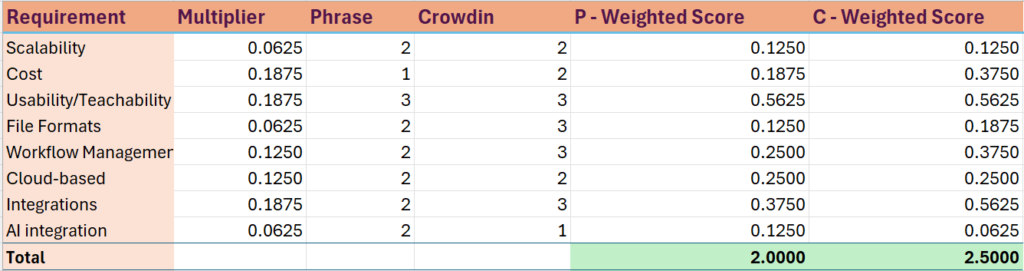
Our discussion panel resulted into the following observations and also a scoreboard on the two systems that “passed” our criteria:
BEST OPTIONS:
In this presentation we go over some more details on the requirements used to compare both management systems and make a final decision:
CONCLUSION & FINAL RECOMMENDATION
Crowdin and Phrase had similar, competitive features that beat the other evaluated options. However, some very important factors brought us to choose Crowdin as the best recommended option for this particular company, based on key aspects Phrase could not surpass such as integrations options and cost. Crowdin and Phrase both offered similar, competitive features that outperformed the other evaluated options. However, several critical factors led us to recommend Crowdin as the best choice for this particular company. Key aspects where Crowdin excelled over Phrase included integration options and cost.
This project was engaging and dynamic, giving us the opportunity to collaboratively research, analyze, evaluate, compare, and discuss some of the most popular and competitive Translation Management Systems on the market today. We look forward to continuing to observe changes and technological advancements in these systems as well as the emergence of new ones. In the future, we will be even better prepared to advise the companies we work with on the most efficient ways to achieve their localization goals.